" LE RED STAR, mémoire d'un club légendaire"
(Extracts, Part Two)
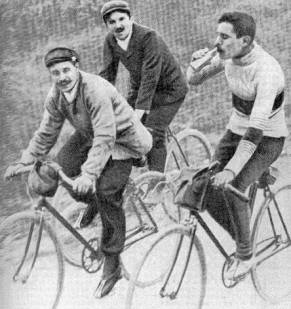
Cycle racing, 1900-style
In 1898, the Union Pédestre de la Rive Gauche ceded its members to the Red Star. The first merger ! This would not be the last. Soon Jules Rimets' club had over one hundred members, which was a lot for that time. Red Star, it has to be said, was eclectic. In rooms in Rue Faber it organised successful wrestling sessions and a billiards league reserved for the club members. The winner in each category received a cue. Entry cost 50 centimes payable at the Toffin café or at the address of M. Modeste Rimet, 76, boulevard de Latour-Maubourg.
In 1900 there was a spell of success for football-rugby for Red Star. The schools team was French champions, and the first team played in the third division. This was just to be a passing phase. The two primary sports of Red Star at the epoch were cycling and athletics. Cycling because at the time it was the number one sport, and also because of the Galerie des Machines. Red Star organized track meetings. One of these, on July 14th 1903 at the public
vélodrome of the Bois de Vincennes (nowadays called the Cipale) goes down in the annals of history. On the programme, the Red Star speed championship, a scratch race between clubs, a 1km handicap, a one hour race without any training with bonuses at 10, 15 and 20 kilometers as well as two motorcyclette races. At the heart of Red Star cycling, a great champion emerged. Under the colours, in 1898 Emile Georget was classed third in the French amateur road championship. He didn’t stop there, either. In 1912 he won the Bordeaux-Paris beating Faber, Petit-Breton, Garrigou etc, not to mention on track, the Bol d'or de Buffalo. He raced on after the Great War and was seen during a race at the Vel' d'Hiv'.
Contrary to cycling athletics failed to attract the French crowds. In Paris, during the Olympic Games of 1900, just a handful of fans came to see the track and field events at the
Croix-Catelan, the home of Racing, the best athletes in the world.
At that time Georges Clément ran the 400 metres in 55 seconds. In its day, an exploit. One must not demean his effort - the track was grass, the start was given standing there were no lanes (these were invented in 1912) and in the final sprint one had to use cycling sprinters tactics, including using ones’ elbows. Just by comparison, during the Athens Games, the American Burke won the 400m in 54 seconds. Another Red Star athlete won the 1500m in 4-31. At Athens he would have been Olympic Champion, because the Australian Flack ran 4-33.2 for the same distance.
Jules Rimets’ club organised interclub grand prix at the Croix-Catelan, loaned by the Racing Club (thanks to the intervention of Charles de Saint-Cyr ) and on the 11th May 1901, organised near the Observatory at Meudon a Spring meeting with a 100m, a 400m a 1500m and a high jump. The posters for the event announced big prizes. Non-financial, obviously. Red Star respected the rules of amateurism to the letter.
During the Winter, Red Star decorated the mists which covered the
Bois de Meudon with colours - the cross-country races were well-known. These were sometimes called Paper-Rallys, as before the race the marshals marked out the course with confetti. Hills, potholes and even thorn bushes were included in the trail, a real test for the athletes. Upon finishing the race, the competitors enjoyed a swift hot toddy before returning to Paris by train, the carriages packed with people.
However, it was not to be cross-country running would bring glory to Red Star.
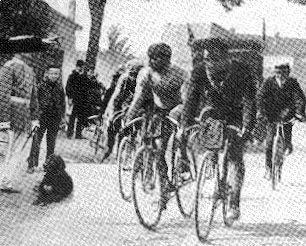
Tour de France, Emile Georget (4th in the 1905 Tour, Louis Trousselier winner 1905 and Lucien Petit-Breton, winner 1907 & 1908
(to be continued)
LE RED STAR,
mémoire d'un club légendaire
by Guillaume Hanoteau, with Gilles Cutulic
© Robert Laffont - Editions Seghers
Dépôt légal : 1983