" LE RED STAR, mémoire d'un club légendaire"
(Extracts, Part Three)
RED STAR AND THE VEL'D'HIV
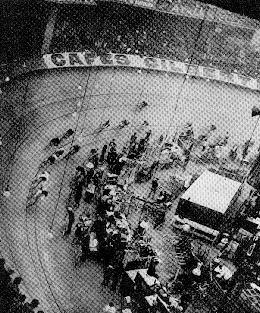
Le Vel' d'hiv 1910 - 1959
"1907 was to another eventful year with two marriages, both of them beneficial. At number 23 avenue de La Bourdonnais, Marcel Klons, a young man just returning from his national service founded in a wine bar, the café Bernard, Amical Football Club du Champ de Mars, a reasonably well-off club. Nevertheless he became less then happy, estimating that there were just too many sporting clubs and that mergers would be a better idea.
Number 23, Avenue de La Bourdonnais ist virtually next door to number 83. Klons contacted Jules Rimet offering his troops and his services. As discussions dragged on Klons had to leave to continue his national service, and whilst he was out in the east, news came through that an agreement had been reached and that from the ashes of the Red Star Club Français and the Amical Football Club arose the Red Star Amical Club.
As one takes the metro train from the Trocadéro to Montparnasse by the elevated line, upon leaving Grenelle station, nowadays called Bir-Hakeim, one can see on the right, in the angle of the Rue Nélaton, an immense wasteground of 20 000m2 which is the envy of many sportsman. What a superb stadium one could construct on this forgotten space ! At that moment in time, a daughter of one of Red Stars' directors was married. What was the link between the marriage and the wasteland ? Simple - the family of the girls' husband were the owners of the wasteland. Many times the family had been requested by several sporting clubs to be able to rent the land, but in the end, it was to the Red Star club that the land was leased.
Shortly afterwards, the passengers in the same train could see Red Stars' players on the land, on a pitch measuring 110 metres by sixty, enclosed by barriers. A superb stadium right in the middle of Paris ! Easy to access, with the Métropolitain, the Petite Ceinture railway, the line to Les Invalides, the Louvre tramway all within easy reach. A perfect pitch, never heavy. No grandstand, but for only 25 centimes, spectators got to watch two games on a Sunday afternoon. For only three francs per month, one could even play on the pitch Sunday mornings against former Red Star players, nicknamed les Vieux débris (Old debris). This was the idea of Ernest Weber.
This was only the beginning. Eventually work started to create a second football pitch, a 400 m athletics track and three tennis courts.
Unfortunately the good times did not last long. After the demolition of the Exposition, the Galerie des Machines became a target for certain people in Paris. The building his the façade of the Ecole militaire and spoilt the view of the Champs-de-Mars. In 1909 they got their wish and the Galerie des Machines and its 333m cycle track was demolished.
But where could the Vélodrome d'Hiver go ? From Novembre to April there were meetings every Sunday. It went to Rue Nélaton, on the former wasteland rented by Red Star. The owners had sold up, and the Vel'dHiv', more pompously known as the Palais des Sports was inaugurated on the 30th October 1910.
Once again the Red Star found itself without a home. Worse still, Jules Rimet resigned from his post of President."
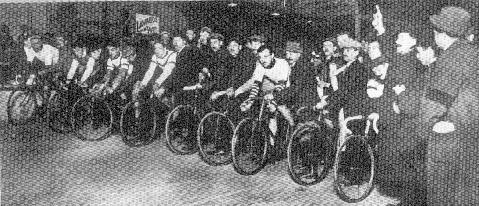
January 1913, the first Six Days of Paris at the Vel' d'hiv, Paris
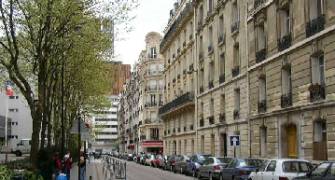
Rue Nélaton (April 2003)
(to be continued)
LE RED STAR,
mémoire d'un club légendaire
by Guillaume Hanoteau, with Gilles Cutulic
© Robert Laffont - Editions Seghers
Dépôt légal : 1983