"LE RED STAR, mémoire d'un club légendaire"
(Extracts, Part twelve)
LA GUERRE DES CLANS
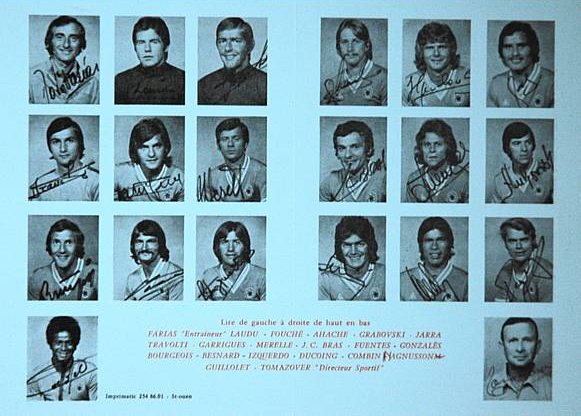
Red Star FC, season 1974-1975
And so football continued at Saint-Ouen, with its highs and lows. The faithful were still there. Unfortunately they watched as their beloved club slid into the second division. The cost of relegation was enormous, but it was worsened by an administrative foul-up with a heavy consequence. Gilbert Zenatti and Jean Doumeng stepped down, and the man appointed to take charge of the club was the deputy mayor of Saint-Ouen, Paul Sanchez.
The supporters discovered this little man with grey hair, a little rotund, jovial, a smooth talker very much armed for political struggles. After one season under his presidency, Red Star regained promotion to the first division thanks to wise, if somewhat expensive, recruitment. Red Star set out for the season 1974-75 in the top flight. But was the situation, exactly ?
They had bought the famous Nestor Combin. They had lured the ageing star Magnusson and brought back Jean-Claude Bras who in 1969 and 1970, had made a brilliant debut with the national team and whom, from US Valenciennes, had moved on to Liège then to Paris Football Club.
But the recruitment continued from there. At that time thanks to the efforts of the Union nationale des footballeurs professionnels (of which Jean-Claude Bras was the general secretary) the old contracts system had been scrapped and now the players were finally masters of their own destinies.
Paul Sanchez, whom in his rôle of Parti communiste français official was receiving a modest wage, suddenly was dealing with millions of francs with the professional footballers. Nothing was too good for Red Star and sometimes it apepared that the president, suddenly confronted by enormous sums of money lost contact with the significance of the value. Despite being a honest and scruplulous individual, he became victim of a struggle between his communist militant activites and his job as football club president. He also risked making errors by incompetence. He launched a salary campaign which was totally inflationary. It isn't easy to run a football club at the top level, and the question begs to be asked if he was really prepared for the task.
Very quickly he had to face up to serious sporting problems. In the team - the poor results didn't help - clans started to form. The South Americans were divided. On one side the Paraguayens Gonzales and Monin and on the other side the Argentinians Farias, Jarra and Combin. The old hands at the club, Ducuing, Garrigues, Laudu and Besnard grouped together. An intellectual friendship between Jean-Claude Bras and André Mérelle formed. Finally the new boys Fouché, Fuentes, Houen, Bourgeois and Magnusson. It needed a strict coach to unite these disparate units of players. José Farias, too easy-going certainly let himself be influenced. Normally he listened to his captain Guy Garrigues and his colleagues. On the other hand, often he was opposed to Carlos Monin. Of course this sort of thing does happen and each pro club has experienced more or less this feature. But at Red Star the facts rapidly took on heavy consequences.
One day Guy Garrigues asked for a meeting with Paul Sanchez. He told him about the existence of these cliques and complained bitterly about the lack of physical preparation during training sessions. The president immediately called for a meeting to clear the air. That eveing at the Ile des Vannes was difficult. Before the meeting, Jean-Claude Bras, usually circumspect about the training methods of José Farias, warned him that he risked danger should he even accept the principle of a meeting. Paul Sanchez, took sides with the players suring the meeting and the decision was taken that José Farias had to run more intense physical preparations. In a way he had lost his authority over the players. Days later he lost his job.
(The end)
LE RED STAR,
mémoire d'un club légendaire
by Guillaume Hanoteau, with Gilles Cutulic
© Robert Laffont - Editions Seghers
Dépôt légal : 1983